Apostille Services Miami: How to Authenticate Your Foreign Documents for International Use
By ITU Translation Services · Published 2026-04-06
Reading time: ~7 min
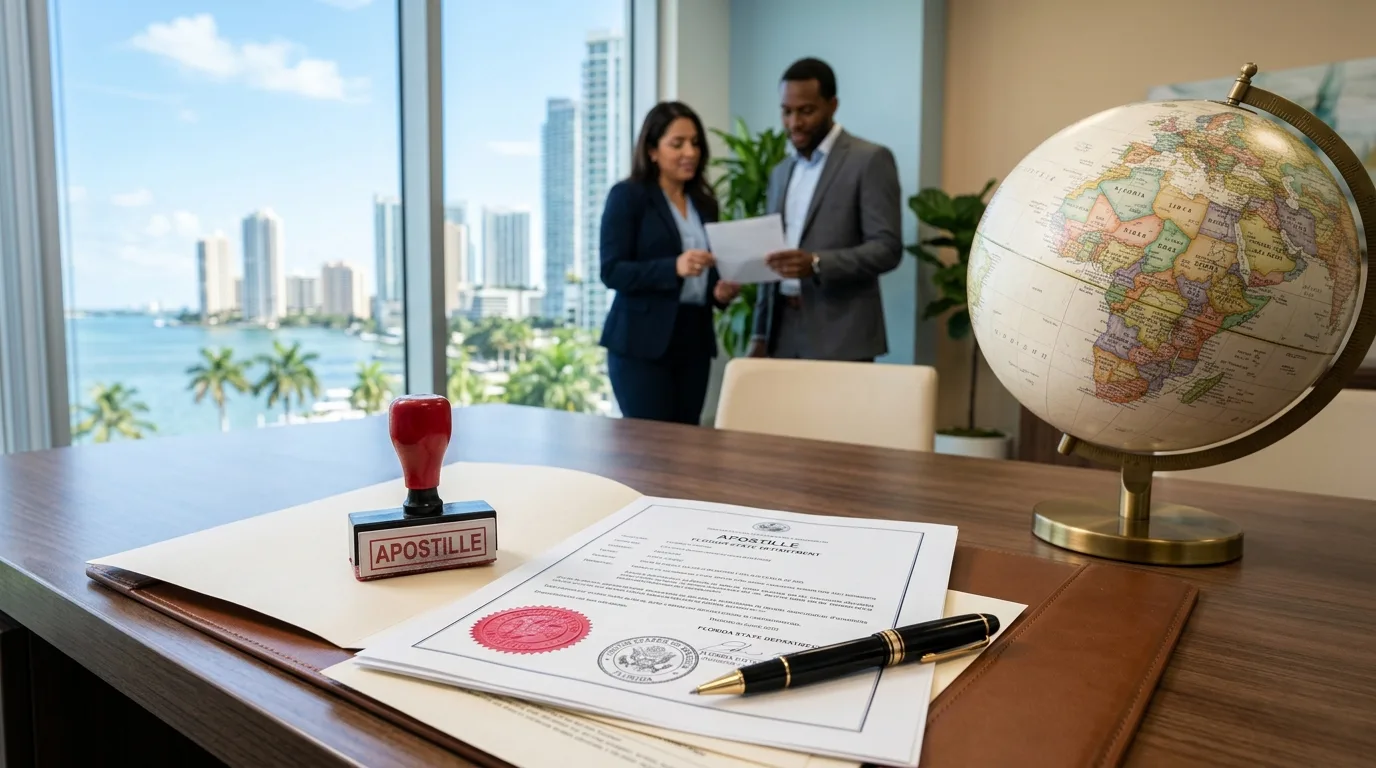
If you’ve ever tried to use a U.S.-issued document abroad — or a foreign document here in the United States — you’ve likely encountered the word apostille. For many Miami residents and businesses, apostille authentication is the crucial final step that makes a document legally valid across international borders. Yet it remains one of the most misunderstood parts of the document authentication process.
At International Translations USA (ITU), our team handles apostille services in Miami every day — for individuals navigating immigration, corporations closing international deals, and families managing estates across countries. In this guide, we’ll walk you through exactly what an apostille is, when you need one, and how to get it done correctly the first time.
Quick Summary
- An apostille is an official government certification that makes your documents legally recognized in 125+ Hague Convention countries
- Florida apostilles are issued by the Florida Department of State — standard processing takes 5–10 business days (expedited: 24–48 hours)
- Many documents require both a certified translation and an apostille — especially for immigration, international business, and foreign court proceedings
- ITU’s team handles the full workflow: translation → notarization → apostille — so you don’t have to coordinate multiple vendors
- Most common documents: birth certificates, marriage/divorce decrees, diplomas, powers of attorney, corporate documents, and FBI background checks
What Is an Apostille? (And Why Does It Matter in Miami?)
An apostille (pronounced “a-pos-TEEL”) is a form of authentication issued to documents for use in countries that participate in the Hague Convention Abolishing the Requirement of Legalisation for Foreign Public Documents — commonly known as the Hague Apostille Convention. As of 2026, more than 125 countries are members of this treaty, including Mexico, Spain, Brazil, Colombia, Argentina, France, Germany, Italy, and dozens more.
In simple terms, an apostille is an official stamp or certificate that tells a foreign government: “This document is genuine, properly signed, and issued by a legitimate authority.” Without it, many countries will not accept your U.S. documents — no matter how authentic they are.
For Miami, this matters enormously. Miami is one of the most internationally connected cities in the United States — the gateway to Latin America and the Caribbean. Our city is home to thousands of residents with ties to Venezuela, Cuba, Colombia, Brazil, Argentina, Haiti, and beyond. Every day, Miami residents need authenticated documents for:
- Applying for residency or citizenship in a foreign country
- Enrolling children in schools abroad
- Getting married overseas
- Inheriting property in another country
- Closing international real estate or business transactions
- Submitting foreign credentials to U.S. institutions
Without an apostille on the right documents, these processes grind to a halt.
How the Apostille Process Works in Florida
In the United States, apostilles are issued at the state level — not the federal level (with a few exceptions like FBI background checks, which go through the U.S. Department of State). For Florida documents, the apostille is issued by the Florida Department of State, Division of Corporations.
Step 1: Confirm Your Document Is Eligible
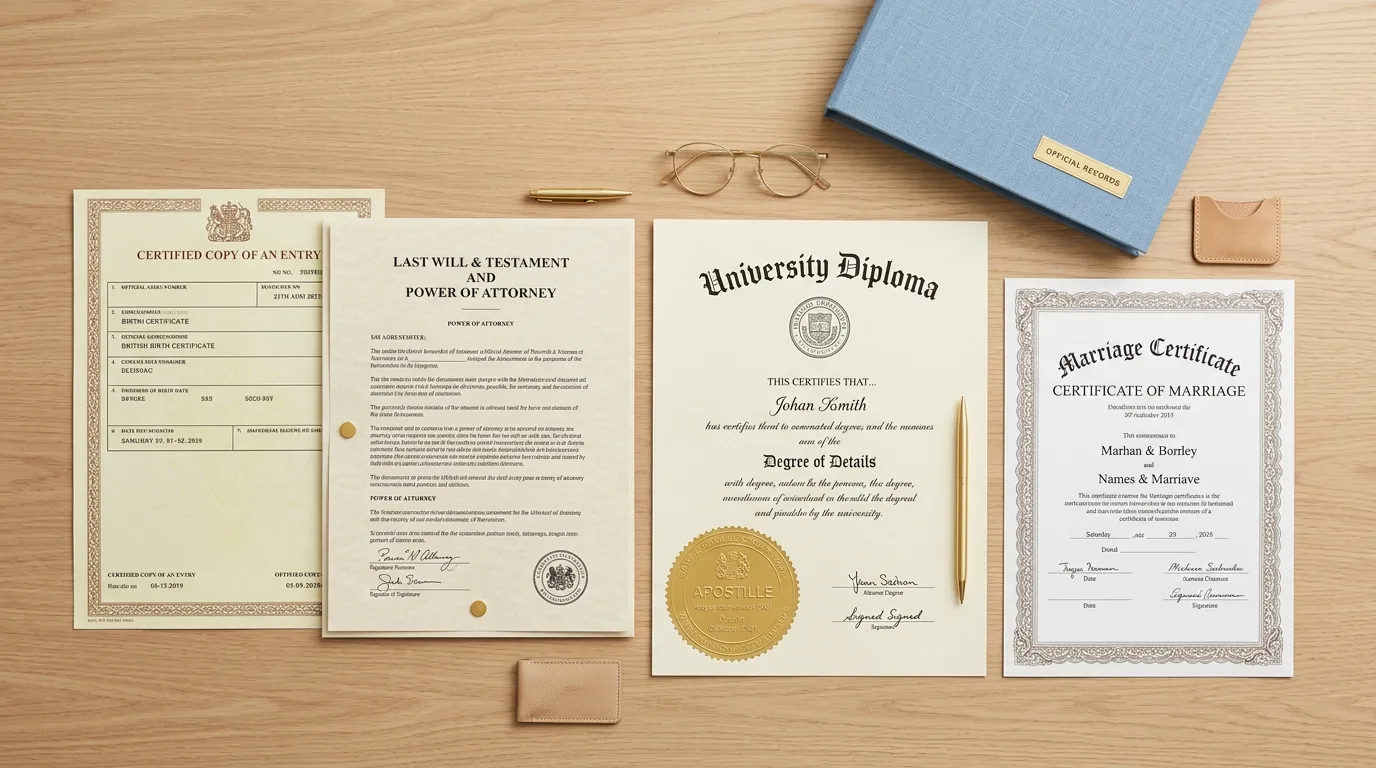
Not all documents can receive an apostille directly. The document must be a public document — meaning it was issued or notarized by a government official or notary public. Common eligible documents include:
- Vital records: Birth certificates, death certificates, marriage certificates, divorce decrees
- Educational records: Diplomas, transcripts, GEDs (if issued by a public institution)
- Legal documents: Powers of attorney, affidavits, court orders
- Corporate documents: Articles of incorporation, certificates of good standing
- FBI background checks (federal apostille from U.S. Dept. of State)
- Notarized translations (when a Florida notary has signed and stamped the document)
Step 2: Obtain a Certified Copy (If Required)
For vital records like birth and marriage certificates, you typically need an official certified copy directly from the issuing government office — not a photocopy. In Florida, these are available from the Florida Bureau of Vital Statistics or the county clerk’s office.
Step 3: Notarize (If Required)
Private documents — like powers of attorney, business affidavits, or personal statements — must first be notarized by a Florida-commissioned notary public before they can receive an apostille. Our team at ITU works with licensed notaries to ensure this step is handled correctly.
Step 4: Submit to the Florida Department of State
The Florida Department of State processes apostille requests either by mail or in person at their Tallahassee office. Processing times vary:
- Standard service: 5–10 business days
- Expedited (in-person, Tallahassee): Same-day or next-day
- Third-party apostille services (like ITU): Often 24–72 hours via established courier relationships
Step 5: Translation (If Required by the Destination Country)
Many countries require that the apostilled document also include a certified translation into the destination country’s official language. For example, if you’re submitting a Florida birth certificate to a Spanish-language country, you’ll typically need both the apostille and a certified Spanish translation.
This is where ITU’s full-service approach becomes invaluable — we handle translation, notarization, and apostille coordination under one roof, eliminating the back-and-forth between multiple vendors.
When Do You Need Both an Apostille AND a Certified Translation?
This is one of the most common questions our Miami team receives — and the answer depends on the destination country’s requirements. Here’s a practical breakdown:
| Scenario | Apostille Needed? | Certified Translation Needed? |
|---|---|---|
| U.S. birth certificate for use in Mexico | ✅ Yes | ✅ Yes (Spanish) |
| Florida diploma for a job application in Germany | ✅ Yes | ✅ Yes (German) |
| Venezuelan marriage certificate for use in U.S. court | ❌ Not applicable | ✅ Yes (English) |
| Power of attorney for a real estate transaction in Colombia | ✅ Yes | ✅ Yes (Spanish) |
| FBI background check for Brazilian visa | ✅ Yes (federal) | ✅ Yes (Portuguese) |
| Divorce decree for remarriage in Spain | ✅ Yes | ✅ Yes (Spanish) |
The bottom line: if your document is leaving the U.S. and heading to a Hague Convention country, assume you need an apostille. If the document is in English and the destination country uses another language, assume you also need a certified translation.
If your document is coming into the U.S. from a foreign country (like a foreign birth certificate or diploma), the apostille verifies its authenticity for U.S. use — and you’ll likely need a USCIS-accepted certified translation as well. Our team can walk you through the certified translation process and what USCIS specifically requires.
Documents We Handle Most Often at ITU Miami
Over the years, our team has authenticated and translated thousands of documents for Miami clients. The most common include:
Birth Certificates
Whether you’re claiming citizenship in a parent’s home country or enrolling in a foreign school, a birth certificate apostille is among the most frequently requested. We’ve handled Florida-issued birth certificates for submission to countries across Latin America, Europe, and the Caribbean.
Marriage and Divorce Certificates
International remarriage, foreign estate claims, and spousal visa applications often require certified copies of marriage or divorce records — apostilled and translated for the destination country.
Diplomas and Academic Transcripts
Miami’s international workforce regularly needs foreign credentials authenticated for U.S. employers, or U.S. diplomas authenticated for international employers and graduate schools. We also offer academic credential evaluation services alongside translation.
Powers of Attorney
Miami’s strong Latin American business community frequently requires powers of attorney — often notarized, apostilled, and translated — for property transactions, corporate decisions, and estate management across borders. Brickell’s corporate corridor generates particularly high demand for these services.
FBI Background Checks
For foreign residency or work visa applications (especially in countries like Spain, Colombia, or Germany), an FBI background check with a federal apostille from the U.S. Department of State is often mandatory. We coordinate the full process: obtaining the check, securing the federal apostille, and providing the certified translation.
Corporate and Business Documents
Articles of incorporation, certificates of good standing, and corporate resolutions often need apostilles for international joint ventures, foreign subsidiary registration, or import/export compliance. Miami’s Brickell corporate corridor generates high demand for these cross-border authentication services.
Why Work With a Professional Apostille Service in Miami?
You can navigate the apostille process on your own — but the risk of errors, delays, and rejected documents is significant. Here’s what our clients consistently tell us after trying to handle it themselves:
- Wrong document version submitted — Many countries require original certified copies, not photocopies. If you send the wrong version, the apostille office will reject it.
- Incorrect notarization — A notarized document with the wrong notary language or an expired notary commission can void the apostille.
- Missing translation — Some clients receive the apostille and then discover the destination country also required a certified translation — causing weeks of additional delays.
- Country-specific requirements missed — Each country has nuances. Some require additional legalizations even with an apostille. Our team stays current on these requirements.
When you work with ITU, we review your specific situation, confirm the exact requirements for your destination country, handle the logistics, and deliver a complete, ready-to-use package. Visit our full services page to learn more about our document authentication and translation services.
ITU’s Apostille Process: Simple and Streamlined
Here’s how our Miami clients experience the process when they work with us:
Step 1: Free consultation. Call or message our team — we’ll ask about your documents, the destination country, and your timeline. We’ll tell you exactly what’s needed.
Step 2: Document submission. Drop off originals at our Miami office, or ship them to us via tracked mail. We can also work with digital copies for the translation phase.
Step 3: Translation and notarization. Our certified translators complete the translation. If notarization is required, our partnered Florida notary signs and stamps.
Step 4: Apostille submission. We submit your documents to the Florida Department of State (or the U.S. Department of State for federal documents) and coordinate expedited processing when your timeline is tight.
Step 5: Delivery. We return your authenticated, translated, apostilled documents via your preferred method — in person, mail, or courier.
Most standard apostille packages are completed in 3–7 business days. Rush service is available for urgent timelines.
FAQ: Apostille Services in Miami
What’s the difference between an apostille and notarization?
Notarization is a local verification — a Florida notary confirms your identity and witnesses a signature. An apostille is an international certification that your document is legitimate for use in foreign countries. Notarization is often a prerequisite for an apostille, but they are separate steps.
Can I get an apostille on a foreign document in Miami?
No — an apostille is issued by the country that issued the document. If you have a Colombian birth certificate, the apostille must come from Colombia’s competent authority. What you can get in the U.S. is a certified English translation accepted for U.S. use. Our team can guide you through this process.
How long does an apostille take in Florida?
Standard processing through the Florida Department of State takes 5–10 business days. With our expedited service, we can often secure apostilles in 24–72 hours. Contact us for timeline-sensitive cases.
Is an apostille valid forever?
An apostille itself doesn’t expire, but some countries require that documents be recently issued (within 3–6 months) for certain applications. Always verify the destination country’s recency requirements.
Do I need a certified translation before or after the apostille?
For documents leaving the U.S., the apostille goes on the original document. The certified translation is a separate document that accompanies it. Both can be prepared simultaneously — which is exactly how ITU processes them.
What if my destination country is not part of the Hague Convention?
Countries not part of the Convention require a more complex process called “legalization” or “authentication” — typically going through the U.S. Department of State and the destination country’s embassy or consulate. Our team handles these cases as well.
Ready to Apostille Your Documents? ITU Miami Is Here to Help.
Whether you’re a Brickell attorney managing an international estate, a Doral family preparing for relocation abroad, or a Coral Gables graduate pursuing a European opportunity — apostille services are faster, smoother, and more reliable when you have the right partner.
At International Translations USA, we’ve authenticated documents for clients across all 50 states and supported submissions to dozens of countries. Our Miami team understands both the legal requirements and the cultural nuances of international document use.
Need certified or professional translation and apostille services in Miami? Contact International Translations USA today — call (305) 747-5996 or request a free quote online.
You can also explore our full range of translation and authentication services or learn more about our team and mission.
Related Reading
ITU Translation Services
ATA corporate member and BBB A+ rated translation agency in Miami, FL. Certified translations in 120+ languages, accepted by USCIS, courts and institutions nationwide since 2017.


Need a certified translation?
Free quote in minutes — USCIS acceptance guaranteed.