Voice Over Services Miami | ITU Translation Services
By ITU Translation Services · Published 2026-06-22

Whether you’re producing a corporate training video, a bilingual TV commercial, or a streaming documentary for Latin American audiences, the quality of your voice over can make or break your project. In Miami — a city where English, Spanish, Haitian Creole, and Portuguese flow freely across neighborhoods — professional voice over services aren’t a luxury. They’re a competitive necessity.
At ITU Translation Services, our Miami-based team offers multilingual voice over production, dubbing, and subtitling for businesses, media companies, legal professionals, healthcare providers, and content creators. In this guide, we break down how voice over works, who needs it, what makes a quality production, and how to choose the right provider in Miami.
What Are Professional Voice Over Services?
Voice over (VO) is the process of recording a narrator or character voice to accompany video, animation, e-learning content, phone systems, or any audio-visual production. It differs from dubbing, though the terms are often used interchangeably:
- Voice over: A translated narration plays over the original audio (common in documentaries, corporate videos, and news broadcasts).
- Dubbing: The original audio is fully replaced with a new language track, with lip movements synchronized to match the speaker’s mouth (common in film, TV shows, and streaming content).
- Subtitling: Text captions appear on screen while the original audio plays — no re-recording required.
- Captioning: Similar to subtitling, but includes descriptions of non-speech audio elements (used for ADA compliance and accessibility).
For Miami companies working across Spanish-speaking markets, Brazil, the Caribbean, or multilingual U.S. audiences, choosing the right format is the first critical decision. ITU’s linguists help you evaluate which approach fits your content type, budget, and audience.
Who Needs Voice Over Services in Miami?
Miami’s status as the gateway to Latin America and a hub of multicultural commerce means voice over demand spans virtually every industry. Common use cases include:
Corporate Training & E-Learning
Miami companies with Spanish-speaking workforces — in hospitality, healthcare, construction, logistics, and manufacturing — need training videos that employees actually understand. Subtitles work in a pinch, but professional voice over in employees’ native language dramatically increases comprehension, retention, and compliance. If your company has locations across Latin America, voice over in regional Spanish dialects (Mexican, Colombian, Argentinian) or Brazilian Portuguese can make the difference between a training that sticks and one that’s ignored.
Legal & Court Proceedings
Law firms in Brickell and downtown Miami increasingly produce video depositions, testimony recordings, and explainer videos that must be accurately translated for multilingual evidence. Accuracy is non-negotiable — a mistranslated phrase in a legal video can derail a case. ITU’s legal translation and interpretation services extend into voice over production for courtroom-quality multilingual media.
Healthcare & Patient Education
Jackson Memorial Hospital, Baptist Health, and dozens of Miami clinics produce patient education videos covering procedure preparation, medication instructions, post-operative care, and more. Under federal language access laws (Title VI, Section 1557), healthcare providers receiving federal funding must provide meaningful access to Limited English Proficient (LEP) patients. A professionally voiced Spanish or Haitian Creole version of your patient video isn’t just good practice — in many cases, it’s required.
Marketing & Advertising
TV and digital advertising for Miami’s Spanish-language market demands more than literal translation. Voice talent, tone, pacing, and cultural nuance all affect whether a viewer connects with your brand. Whether you’re running a Spanish-language ad on Univision or a YouTube pre-roll targeting Colombian expatriates in Doral, the voice talent needs to sound authentic — not like a translated script read robotically by a non-native speaker.
Streaming, Film & Media Production
Miami has a growing film and media production scene. Documentaries, independent films, YouTube channels, and Netflix-distributed content regularly require multilingual voice over and dubbing. Florida’s new production incentives have drawn more media projects to the region, increasing demand for local multilingual post-production services.
Government & Public Information
Miami-Dade County is one of the most linguistically diverse counties in the United States, with over 67% of residents speaking a language other than English at home. Government agencies, school boards, and public health departments regularly produce multilingual public service announcements and information videos — a growing area for professional voice over services.
What Makes a Quality Voice Over? 5 Factors to Evaluate
Not all voice over is created equal. Here’s what separates a professional multilingual production from a rough translation with a generic AI narrator:
1. Native-Speaker Voice Talent
Your voice talent should be a native speaker of the target language — not just fluent. Accent, cadence, regional expression, and emotional tone are things that native speakers carry naturally. A Mexican Spanish voice talent and a Castilian Spanish voice talent will sound entirely different, and your Miami audience will notice. ITU works with a vetted roster of native-speaker talent across Spanish dialects, Brazilian Portuguese, French, Haitian Creole, Mandarin, and dozens of other languages.
2. Translation Quality Before Recording
The voice over script must be a professional translation — not a machine translation run through an AI tool. Google Translate and DeepL produce functional text, but they fail with idioms, cultural references, humor, and the natural rhythm of spoken language. A script that reads fine on the page can sound stilted, unnatural, or even offensive when spoken aloud in another language. Our translators optimize scripts for spoken delivery, not just written accuracy.
3. Lip-Sync and Timing (for Dubbing)
When full dubbing is required, the translated script must be adapted to match the original speaker’s lip movements — a process called “lip-sync dubbing” or “lip-flapping.” This requires a skilled adaptation writer, not just a translator. Syllable counts and vowel sounds must approximate the original language enough that the dub looks and feels natural. ITU’s dubbing team includes experienced adapters who specialize in this complex workflow.
4. Studio-Quality Audio Production
Even the best voice talent can’t save a recording captured in a reverberant room on a consumer microphone. Professional voice over requires studio-grade equipment, proper acoustic treatment, noise editing, and final audio mastering. ITU coordinates with recording studios to ensure every deliverable meets broadcast and streaming technical specifications.
5. Quality Control by a Second Linguist
Every voice over script goes through a two-step quality check: a human translator produces the script, and a second native-speaking linguist reviews the recording against the original for accuracy, tone, and naturalness. This is the same QC standard used in medical and legal translation — and it should apply to your media production too.
Voice Over for Latin American Markets: Miami’s Unique Position
Miami is home to the largest concentration of Latin American corporate headquarters outside of Latin America itself. Brands headquartered in Brickell or Coral Gables routinely produce content for audiences in Mexico City, Bogotá, São Paulo, and Buenos Aires simultaneously.
This creates a nuanced challenge: Spanish is not one language. “Neutral Spanish” (a standardized form used in dubbing to reach broad audiences) works for some content, but local markets increasingly prefer regional voices. A company selling to Mexican consumers benefits from Mexican Spanish. A healthcare provider serving a predominantly Cuban-American Miami population should use a voice talent that reflects that community.
ITU’s roster includes voice talent across the full spectrum of Spanish-speaking regions and Brazilian Portuguese — along with linguists who can advise on dialect strategy before a single recording session is booked.
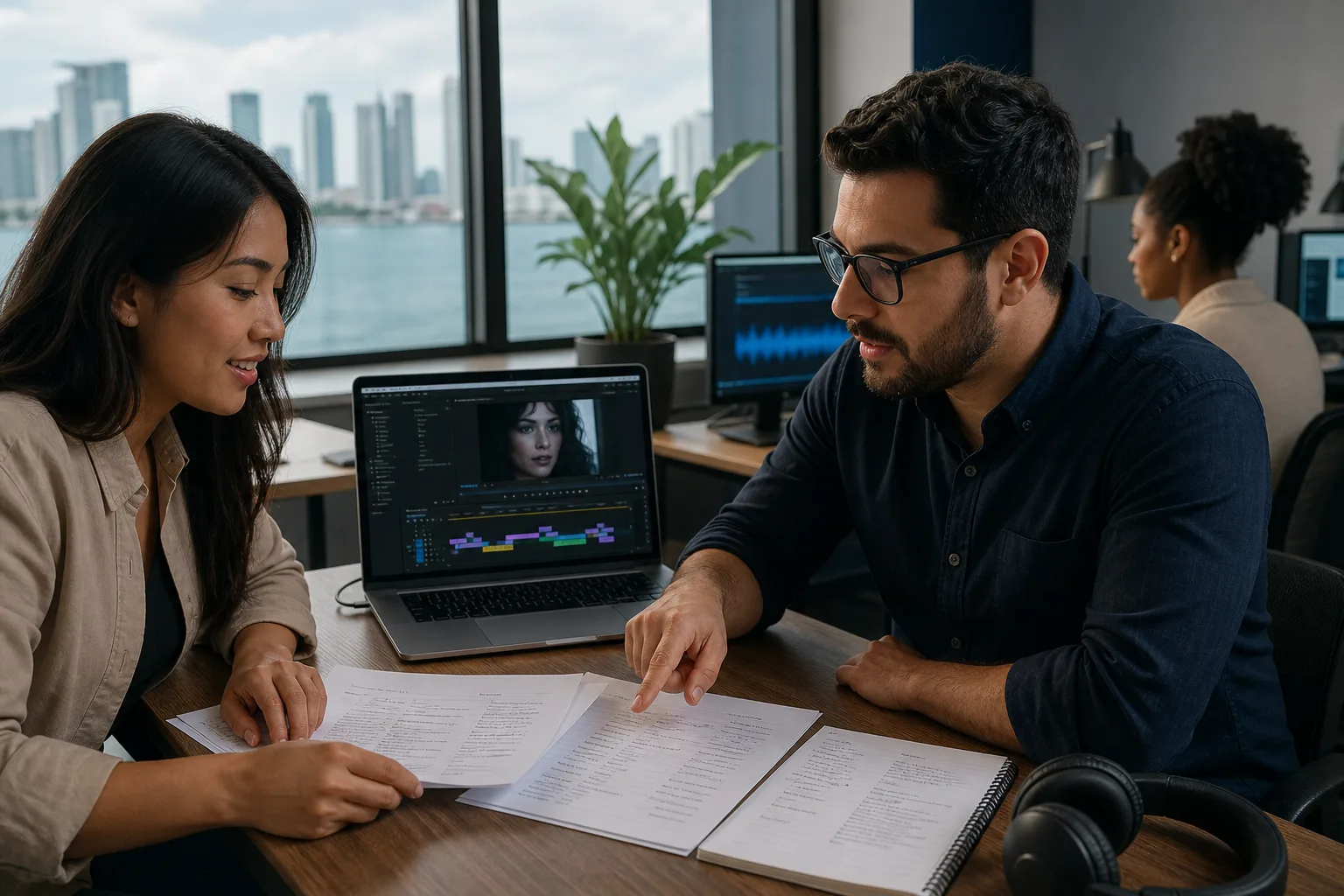
Voice Over vs. Subtitles: Which Is Right for Your Content?
Both approaches serve legitimate purposes. The choice depends on your audience, your content type, and your budget:
| Factor | Voice Over / Dubbing | Subtitles / Captions |
|---|---|---|
| Cost | Higher (recording + talent + studio) | Lower (translation + timing only) |
| Viewer engagement | Higher — no reading required | Lower — requires reading while watching |
| Accessibility | Ideal for audiences with low literacy | Ideal for hearing-impaired viewers |
| Healthcare / training | Strongly preferred | Adequate for simple content |
| Film / streaming | Dubbing preferred for immersive content | Subtitles widely accepted globally |
| Turnaround | Longer (talent scheduling, studio booking) | Faster (translation + file formatting) |
For many Miami businesses, the right answer is both: a subtitled version for digital accessibility compliance and a voiced version for primary audience engagement. ITU can produce both workflows in parallel from a single translation pass, reducing overall cost and turnaround time.
How ITU Handles Voice Over Projects in Miami
Working with ITU on a multilingual voice over project follows a clear, professional workflow designed to protect quality at every stage:
- Brief & scope review: We review your video file(s), source language, target language(s), format requirements, and deadline.
- Script translation & adaptation: Our translators produce a spoken-language-optimized script in the target language. For dubbing, our adapters adjust for lip-sync timing.
- Voice talent selection: We present native-speaker talent options matched to your content’s tone — corporate, conversational, authoritative, warm, instructional, or character-driven.
- Recording: Voice sessions are conducted in a professional studio environment. For projects requiring multiple languages, we can stage parallel recording sessions.
- Audio editing & sync: Recorded audio is cleaned, edited, and synced to picture. Levels are mastered to match your video’s technical requirements (broadcast, web, or streaming specs).
- QC review: A second native-speaking linguist reviews the final audio against the source script for accuracy, tone, and natural delivery before delivery.
- Final delivery: We deliver in your required format — MP4 with embedded audio, separate WAV/MP3 stems, SRT subtitle files, or full project files for your editor.
Need something faster? ITU also handles rush voice over projects for Miami businesses with tight deadlines. Contact our team to discuss expedited scheduling.

Languages Available for Voice Over at ITU
ITU’s voice over services cover 120+ languages and dialects, with particular strength in the languages most relevant to Miami’s business community:
- Spanish — neutral/standard, Mexican, Colombian, Cuban, Argentinian, Venezuelan, Puerto Rican, Dominican
- Brazilian Portuguese
- Haitian Creole
- French — standard and Canadian French
- Mandarin and Cantonese
- Arabic — Modern Standard Arabic and regional dialects
- German, Italian, Japanese, Korean — and dozens more
If your project requires a language not listed here, contact us — our network of linguists and voice talent spans every major world language.
Related Articles
- How to Localize Your Website for Latin American Markets
- What Industries Need Translation Services Most? A Miami Business Guide
- Medical Interpretation vs. Medical Translation: What Miami Healthcare Providers Need to Know
- 10 Questions to Ask Before Hiring a Translation Agency in Miami
Get a Quote for Voice Over Services in Miami
Ready to reach your multilingual audience with a professional voice? ITU Translation Services delivers broadcast-quality multilingual voice over, dubbing, subtitling, and captioning for Miami businesses and media producers. Our team speaks your language — literally.
Call us at (305) 747-5996 or request a free quote online to discuss your project. We serve clients across Miami-Dade County, Broward County, and throughout the United States.
Looking for other language services? Visit our full services page to explore certified translation, legal interpretation, document translation, website localization, and more.
ITU Translation Services
ATA corporate member and BBB A+ rated translation agency in Miami, FL. Certified translations in 120+ languages, accepted by USCIS, courts and institutions nationwide since 2017.



Need a certified translation?
Free quote in minutes — USCIS acceptance guaranteed.