How to Localize Your Website for Latin American Markets: A Miami Business Guide
By ITU Translation Services · Published 2026-05-04

Miami has always been a gateway to Latin America — and in 2026, that gateway is increasingly digital. Whether you’re a Brickell-based financial firm expanding into Colombia, a Coral Gables healthcare company entering the Brazilian market, or a local e-commerce brand targeting Mexican consumers, your website is your first impression. And if that website isn’t properly localized, you’re leaving real revenue on the table.
But here’s the thing most businesses get wrong: localization is not the same as translation. Simply running your web copy through a translation tool — or even hiring a competent translator — gets you only part of the way there. True website localization for Latin American markets means adapting your content, design, user experience, currency formats, legal disclaimers, images, and SEO strategy to feel native to each market.
At ITU (International Translations USA), our team has helped hundreds of Miami-area businesses and national corporations successfully localize their digital presence for Latin American audiences. This guide covers exactly what that process looks like — and what you need to get right.
Quick Summary- Localization goes far beyond translation — it includes UX, cultural tone, local SEO, and legal compliance.
- Latin America is not one market — tailor your approach for Mexico, Brazil, Colombia, Argentina, and others separately.
- Spanish localization must account for regional vocabulary differences (e.g., Mexico vs. Argentina vs. Spain).
- Brazilian Portuguese requires fully separate localization from Spanish-language content.
- Trust signals like local phone numbers, regional certifications, and local testimonials dramatically improve conversions.
Table of Contents
- Translation vs. Localization: What’s the Difference?
- Latin America Is Not One Market
- Language & Regional Dialect Considerations
- UX, Design & Cultural Adaptation
- Local SEO for Latin American Markets
- Legal & Compliance Considerations
- Building Local Trust Signals
- How ITU Helps Miami Businesses Go Global
- Frequently Asked Questions
1. Translation vs. Localization: What’s the Difference?
Translation converts words from one language to another. It’s a necessary foundation, but it doesn’t account for cultural context, regional idioms, UX expectations, or buyer psychology.
Localization goes deeper. It asks: How does a user in Mexico City, São Paulo, or Bogotá actually experience a website? What colors convey trust or danger in their culture? What payment methods do they expect to see? Is a phone number in Miami’s (305) area code reassuring — or a red flag that this company isn’t really “for them”?
A 2023 CSA Research study found that 76% of consumers prefer to buy products with information in their own language, and 40% said they would never buy from a website not in their language. For Latin American markets specifically, where e-commerce adoption has grown over 25% annually since 2020 (Statista, 2024), this distinction can make or break your market entry.
At ITU, our linguists don’t just translate — they localize. Every project goes through native-speaking professionals who understand the cultural nuances of each target market, ensuring your message lands the same way in São Paulo as it does in Miami.
2. Latin America Is Not One Market
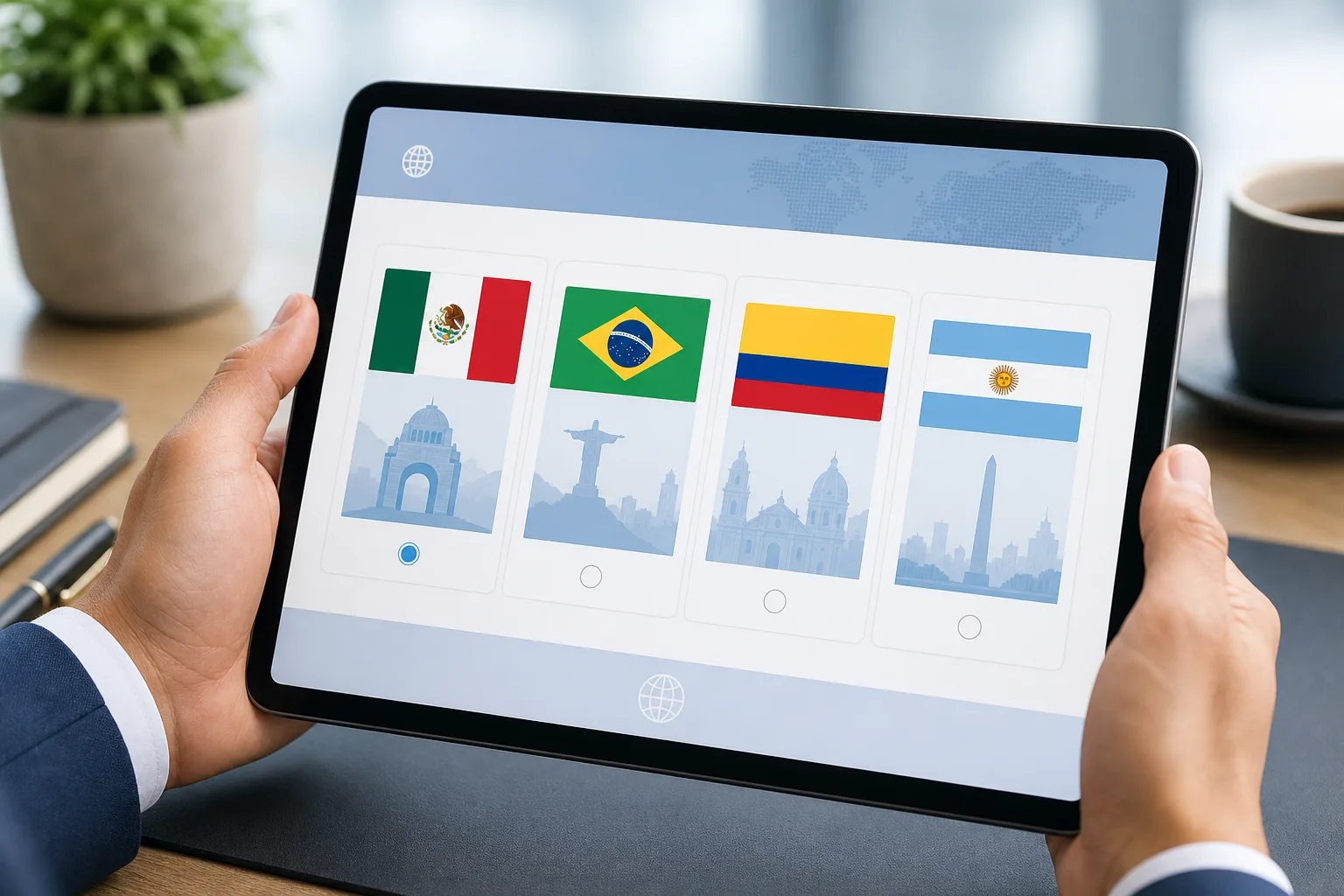
One of the most costly mistakes businesses make is treating “Latin America” as a single, homogeneous market. It isn’t. Here are just a few of the critical differences:
| Country | Language | Key Considerations |
|---|---|---|
| Mexico | Spanish (Mexico) | Formal “usted” common in business; local slang varies by region; MXN currency |
| Brazil | Brazilian Portuguese | Completely separate language track from Spanish; BRL currency; LGPD privacy law |
| Colombia | Spanish (Colombia) | Very formal tone; “usted” expected even in casual contexts; COP currency |
| Argentina | Spanish (Argentina) | “Vos” instead of “tú”; Rioplatense dialect; different pop culture references; ARS currency |
| Chile | Spanish (Chile) | Distinct Chilean slang (“chilenismos”); CLP currency; high e-commerce sophistication |
Miami, uniquely, serves as the commercial capital of Latin America — companies based in Brickell and Doral routinely manage operations across five or more of these markets simultaneously. That’s precisely why professional, market-specific localization is not a luxury but a strategic necessity.
3. Language & Regional Dialect Considerations
Even within Spanish, there is no single “Latin American Spanish.” Key vocabulary differences can signal to a reader that your content was written for a different market — or worse, mistranslated entirely.
Consider just a few examples:
- Car: “carro” (Mexico, Colombia) vs. “auto” (Argentina, Chile) vs. “coche” (Spain — don’t use for LATAM)
- Computer: “computadora” (Mexico) vs. “computador” (Colombia, Chile) vs. “ordenador” (Spain — avoid for LATAM)
- Apartment: “departamento” (Mexico) vs. “apartamento” (Colombia, Venezuela)
- Cell phone: “celular” (most of LATAM) vs. “móvil” (Spain — can feel foreign in LATAM)
For B2B communications — particularly in legal, medical, or financial sectors — using the wrong register or terminology can undermine your credibility instantly. Our professional linguists at ITU are native speakers from their respective markets, which means they naturally write in the vocabulary, tone, and formality level your target audience expects.
Brazilian Portuguese is an entirely separate matter. It is not a dialect of Spanish — it is a distinct language. Any business targeting Brazil must maintain a completely separate Portuguese localization track, with its own native speakers, SEO keyword research (Portuguese search terms differ significantly from Spanish), and cultural references.
4. UX, Design & Cultural Adaptation
Language is only the beginning. Effective website localization for Latin American markets also requires rethinking your user experience and visual design:
Color psychology varies by culture. In many Latin American markets, vibrant, warm colors convey energy and trust — while the minimalist cool-white aesthetic common in US tech products can feel sterile or impersonal. Similarly, imagery that feels diverse and relatable to a Miami audience may not resonate in markets where local representation matters deeply.
Date and number formats differ. Latin America uses DD/MM/YYYY (not MM/DD/YYYY). A date written as “04/05/2026” means May 4th in the US — but April 5th throughout most of Latin America. This matters enormously for legal documents, appointments, and e-commerce order confirmations. Decimal separators also differ: many Latin American countries use a comma as the decimal separator (e.g., “1.500,00” instead of “1,500.00”).
Payment methods and currency. Latin American consumers use payment methods that often don’t exist in the US market — including Boleto Bancário (Brazil), OXXO Pay (Mexico), PSE (Colombia), and local installment payment options. Showing only Visa/Mastercard can signal that your business doesn’t truly serve local customers.
Mobile-first is even more critical. Mobile internet usage rates across Latin America exceed 70% of all web traffic in several countries (GSMA, 2024). Your localized site must be fully optimized for mobile — including load speed on variable bandwidth connections.
5. Local SEO for Latin American Markets
A properly localized website should also be discoverable in local search results. This requires more than translating your existing SEO strategy — it means rebuilding it from the ground up for each market.
Key considerations include:
- Separate URL structures or subdomains. Use country-specific subdomains (mx.yoursite.com, co.yoursite.com) or subdirectories (/mx/, /co/) with proper hreflang tags. This signals to Google which version of your content to serve in each market.
- Keyword research in the target language. Search volumes and keyword intent differ significantly between markets. The top-performing keyword in Mexico may rank for almost nothing in Argentina. Proper keyword research should be conducted using local Google.com.mx, Google.com.co, etc. data.
- Hreflang implementation. Every localized page needs correct hreflang tags (e.g.,
hreflang="es-MX",hreflang="pt-BR") pointing to the correct regional variant. Errors here cause Google to serve the wrong language version to users — and can trigger duplicate content penalties. - Local link building. Earning backlinks from local Latin American publications, industry associations, and .com.mx / .com.br / .com.co domains significantly boosts rankings in each country’s search results.
Many Miami businesses that work with ITU use our website and app localization services as the foundation for their LATAM SEO expansion — because accurate, culturally native copy is the prerequisite for everything else.
6. Legal & Compliance Considerations
Every Latin American market has its own legal environment, and your localized website must comply with it:
- Brazil — LGPD (Lei Geral de Proteção de Dados): Brazil’s privacy law (similar to GDPR) requires specific cookie consent notices, privacy policies, and data handling disclosures in Brazilian Portuguese. Failure to comply can result in fines of up to 2% of your company’s revenue in Brazil.
- Mexico — LFPDPPP: Mexico’s Federal Law on Protection of Personal Data Held by Private Parties requires a privacy notice (“Aviso de Privacidad”) that must be accessible on your site and must meet specific content requirements.
- Terms & Conditions: Generic US terms and conditions are often unenforceable in Latin American jurisdictions. A localized terms of service, written or reviewed by a local legal professional and translated by a certified legal translator, is best practice for any company conducting commerce in the region.
- Consumer protection disclosures: Several Latin American markets require specific consumer disclosures — pricing in local currency, return policies in plain language, and regulated claims language for healthcare or financial products.
Our team at ITU provides certified legal translation for all of these compliance documents. Given our base in Miami’s legal corridor — steps from Brickell’s law firm district — we work closely with attorneys who specialize in Latin American regulatory compliance.

7. Building Local Trust Signals
Perhaps the most underrated aspect of website localization is trust. Consumers in Latin American markets apply the same scrutiny to foreign websites that US consumers apply to unfamiliar brands. You need to signal that you are legitimate, local (or at least deeply familiar with their market), and reliable.
Effective local trust signals include:
- Local contact information. A local phone number or WhatsApp contact (WhatsApp is the dominant messaging platform across Latin America) significantly increases conversion rates compared to a US-only contact number.
- Testimonials and case studies from regional clients. Prospects want to see that you’ve worked successfully with companies in their country — not just generic testimonials from unnamed US clients.
- Locally recognized certifications or partnerships. If your industry has regional certification bodies or well-known associations, display those credentials prominently.
- Regional pricing and currency display. Showing prices in local currency (even with a note that you transact in USD) significantly reduces buyer friction.
- Culturally familiar imagery. Stock photos of US office settings, US ethnic demographics, or US cityscapes can subtly signal “this brand isn’t really for me” to a prospect in Mexico City or Medellín.
At ITU, when we localize website content for clients, we include a trust audit — reviewing all elements of the page that affect perceived credibility in each target market, not just the text. You can learn more about our approach on our About Us page or explore why clients choose ITU for their most important localization projects.
8. How ITU Helps Miami Businesses Go Global
As a full-service Language Service Provider headquartered in Miami — the undisputed gateway to Latin America — ITU is uniquely positioned to support your LATAM expansion:
- 120+ languages and dialects covered, including all major Latin American Spanish variants and Brazilian Portuguese
- Industry-specialized linguists for legal, medical, financial, and technology content
- Website and app localization from content strategy through technical implementation
- Desktop publishing (DTP) for multilingual print and digital collateral
- Certified translations for compliance documents, terms of service, and regulated industries
- Voice over and subtitling for video content requiring full audiovisual localization
Whether you’re launching a new market or refreshing a website that hasn’t performed as expected, our team can walk you through a localization strategy that actually converts. Review all of our translation and localization services, or take the first step today.
Ready to localize your website for Latin America? Contact International Translations USA today — call (305) 747-5996 or request a free quote online. Our Miami-based team is ready to help you reach the world’s fastest-growing digital markets.
Frequently Asked Questions
How long does it take to localize a website for Latin American markets?
A typical 15–25 page business website takes 2–4 weeks for a single-market localization (e.g., Mexico or Brazil), assuming all source content is finalized. Multi-market localizations (e.g., Spanish + Portuguese across 4–5 countries) can take 6–10 weeks depending on technical implementation complexity. ITU offers expedited timelines for clients with urgent launch deadlines.
Do I need separate localizations for Mexico, Colombia, and Argentina?
For maximum impact, yes — especially for B2C brands, healthcare companies, and legal service providers where trust and local credibility are paramount. For simpler B2B websites, a single “Latin American Spanish” localization can work as a first step, though you should invest in country-specific versions as your presence grows. Always treat Brazil as an entirely separate project (Brazilian Portuguese is not Spanish).
What’s the difference between machine translation and professional localization?
Machine translation tools like DeepL or Google Translate can produce a rough draft that’s 70–80% accurate for simple content. However, they consistently fail on idiomatic expressions, legal and medical terminology, cultural nuances, brand voice, and SEO keyword intent. For a public-facing website representing your brand in a new market, professional localization by native-speaking subject matter experts is the standard — not a luxury.
Does ITU handle the technical side of website localization (hreflang, CMS setup)?
ITU specializes in linguistic and cultural localization — the content, copywriting, and translation components. For the technical implementation (CMS configuration, hreflang tags, subdomain setup), we work with your web development team or can refer you to trusted technical partners. We provide detailed localization specifications that any competent developer can implement.
Can ITU localize video and audio content for Latin American markets?
Yes. Our voice over, dubbing, and subtitling services cover all major Latin American markets and languages. We work with Netflix, YouTube, streaming platforms, corporate training content, and marketing videos of all formats. Contact our team for a project-specific quote.
Related Articles

ITU Translation Services
ATA corporate member and BBB A+ rated translation agency in Miami, FL. Certified translations in 120+ languages, accepted by USCIS, courts and institutions nationwide since 2017.



Need a certified translation?
Free quote in minutes — USCIS acceptance guaranteed.