How to Translate Foreign Academic Credentials in Miami: A Complete Guide
By ITU Translation Services · Published 2026-04-28

- Foreign academic credentials — diplomas, transcripts, and certificates — must be translated by a certified professional before U.S. universities, employers, or licensing boards will accept them.
- Miami’s immigrant-rich population makes academic credential translation one of the most in-demand language services in South Florida.
- The process involves certified translation, credential evaluation by a NACES- or AICE-member agency, and often notarization or apostille for added authentication.
- Working with a full-service Miami translation provider like ITU saves time by bundling translation, evaluation coordination, and notarization under one roof.
- Turnaround times range from 24 hours (rush) to 5–7 business days (standard), depending on document complexity and language pair.
Estimated reading time: 8 minutes
If you earned a degree, diploma, or professional certification outside the United States, you already know the sinking feeling: “Will anyone here actually recognize my education?” Whether you’re applying to a graduate program at the University of Miami, pursuing a nursing license through the Florida Board of Nursing, or simply trying to land a job that matches your qualifications, the answer starts with one critical step — getting your foreign academic credentials properly translated and evaluated.
Miami is uniquely positioned for this challenge. According to the U.S. Census Bureau, more than 58 percent of Miami-Dade County residents speak a language other than English at home, and nearly 40 percent of the county’s population is foreign-born. From Brickell professionals relocating from São Paulo to Doral families arriving from Bogotá, thousands of Miami residents navigate the credential translation process every year. At International Translations USA (ITU), our Miami-based team handles academic credential translations in over 120 languages — and we’ve seen firsthand how the right process makes all the difference.
Why Foreign Academic Credentials Need Certified Translation
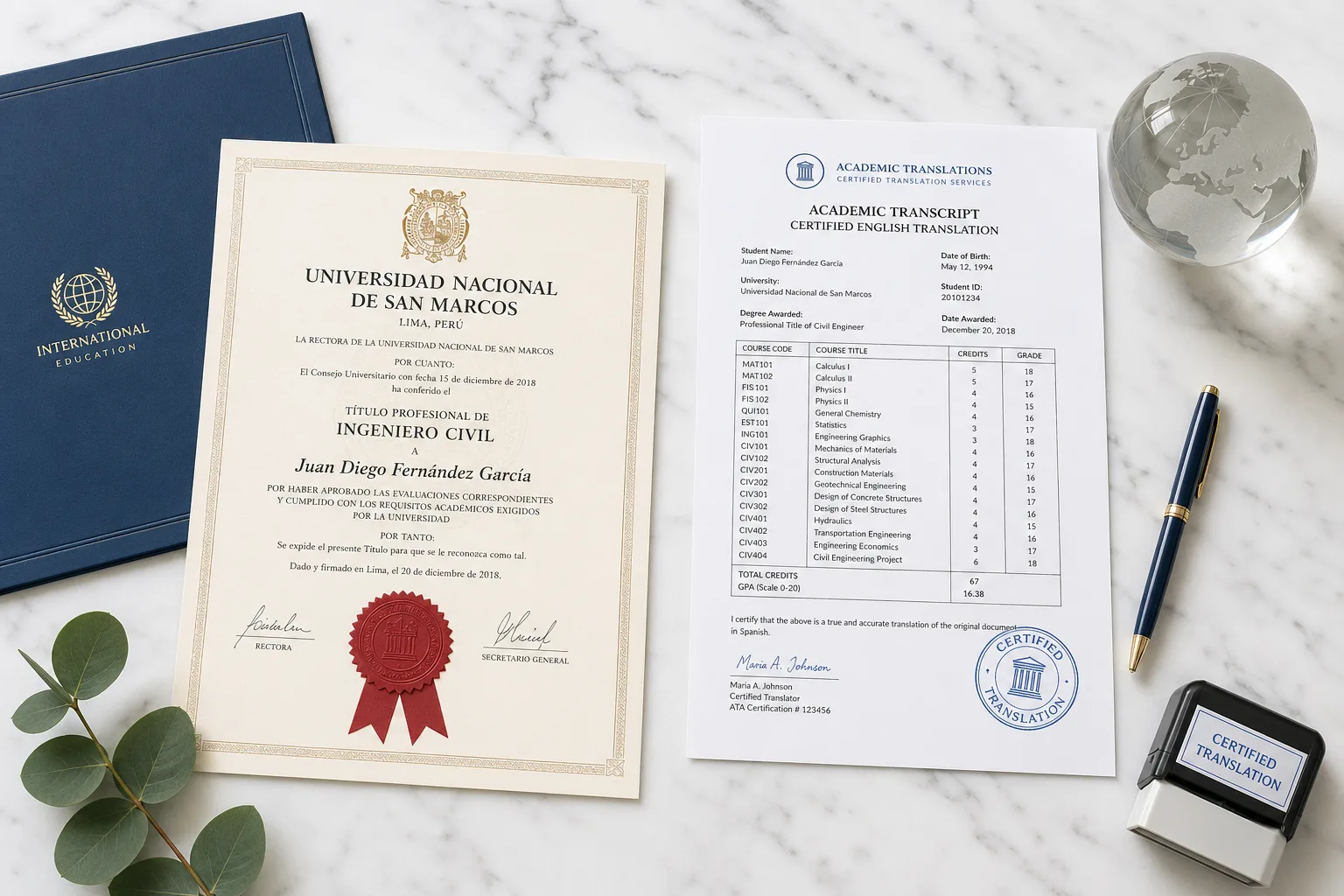
U.S. institutions don’t simply accept a photocopy of your foreign diploma. The document needs to be translated into English by a qualified professional who can certify the accuracy of the translation. This is known as a certified translation — a translated document accompanied by a signed statement from the translator (or translation company) attesting that the translation is complete and accurate to the best of their knowledge.
Certified translations are required by:
- Universities and colleges — for admissions, transfer credits, and graduate program applications
- Professional licensing boards — including the Florida Board of Nursing, the Florida Bar, and medical licensing authorities
- Employers — particularly in regulated industries like healthcare, engineering, and education
- USCIS — for immigration petitions that include academic qualifications (H-1B, EB-2, EB-3 visas)
- Credential evaluation agencies — such as WES, ECE, and other NACES or AICE members
A translation by a bilingual friend or family member — no matter how fluent — will almost always be rejected. The certifying institution needs assurance that the translation was performed by a professional with subject-matter expertise and accountability. That’s where a professional certified translation service comes in.
What Documents Count as “Academic Credentials”?
The term is broader than most people realize. Academic credentials include any official document issued by an educational institution, and each may need its own translation. Common documents our team translates for Miami clients include:
- University diplomas and degree certificates
- Official transcripts (with course titles, grades, and credit hours)
- High school diplomas and secondary school certificates
- Professional certifications and licenses (medical, engineering, teaching)
- Course descriptions and syllabi (often required for credit transfer evaluations)
- Letters of enrollment or completion
- Research publications or thesis abstracts (for graduate admissions)
Each document type has its own formatting conventions depending on the country of origin. A Brazilian histórico escolar looks nothing like a German Zeugnis or a Chinese 成绩单. Our linguists at ITU are trained to preserve the original formatting, grading scales, and institutional terminology so evaluators can interpret them accurately.
The Credential Translation Process: Step by Step
Navigating the process doesn’t have to be overwhelming. Here’s the typical workflow when you work with a Miami-based translation provider like ITU:
Step 1: Gather Your Original Documents
Start by collecting certified copies (or high-quality scans) of every academic document you need translated. Most agencies — including ITU’s academic translation team — accept digital scans submitted via email or a secure upload portal. If your documents are in a language that uses a non-Latin script (Arabic, Chinese, Korean, Russian, etc.), make sure the scans are clear and legible.
Step 2: Certified Translation
A professional translator — ideally one with experience in academic and educational documents — translates each document into English. The translation preserves:
- All institutional names, seals, and signatures (noted in the translation)
- Grading scales and GPA equivalences (when applicable)
- Course titles and credit hours exactly as they appear
- Dates in U.S. format (month/day/year) with the original format noted
The translator then signs a Certificate of Accuracy, affirming that the translation is a true and faithful rendering of the original document. At ITU, every academic translation is reviewed by a second linguist before certification — a quality control step that catches formatting errors and terminology inconsistencies.
Step 3: Credential Evaluation (If Required)
Many universities and licensing boards don’t just want a translation — they want a credential evaluation from an approved agency. This evaluation compares your foreign degree to its U.S. equivalent. For example, a four-year licenciatura from a Mexican university might be evaluated as equivalent to a U.S. bachelor’s degree.
The most widely accepted evaluation agencies are members of NACES (National Association of Credential Evaluation Services) or AICE (Association of International Credential Evaluators). Popular choices include:
- World Education Services (WES)
- Educational Credential Evaluators (ECE)
- Foundation for International Services (FIS)
- SpanTran
These agencies require certified English translations of all documents. Some accept translations only from approved providers — which is why using a recognized translation agency like ITU, rather than a freelance translator, matters. Our translations are accepted by all major evaluation agencies.
Step 4: Notarization or Apostille (When Needed)
Certain institutions, employers, or government agencies require an extra layer of authentication. A notarized translation includes a notary public’s seal confirming the translator’s identity and signature. An apostille — issued under the Hague Convention — provides international authentication recognized by over 120 countries.
ITU offers both notarization and apostille services in-house, which means you don’t need to coordinate between multiple providers. Our Brickell office handles the entire chain — translation, notarization, and apostille — so your documents are ready for submission in a single visit or shipment.

Common Mistakes That Delay Academic Credential Translation
After processing thousands of academic translations at our Miami office, we’ve identified the mistakes that cause the most delays:
- Submitting incomplete documents. A transcript without the degree certificate (or vice versa) often triggers a request for additional materials from the evaluation agency. Always submit the full set.
- Using machine translation. Google Translate and similar tools cannot produce a certified translation. Evaluation agencies and universities will reject them outright. A 2024 study by the American Translators Association found that machine translations of academic documents had error rates exceeding 30 percent on specialized terminology.
- Not checking evaluation agency requirements first. WES, ECE, and other agencies each have specific formatting and submission requirements. Some require documents sent directly from the issuing institution. Verify the requirements before ordering your translation.
- Waiting until the deadline. Standard academic translation takes 5–7 business days. Credential evaluation can take 2–8 weeks on top of that. If you’re applying to a fall semester program, start the process in early spring — not the week before the deadline.
- Choosing the cheapest translator available. A $20 Fiverr translation may cost you months if it’s rejected by the evaluation agency. Professional translation by a recognized provider is an investment in your academic and professional future.
How Long Does Academic Credential Translation Take?
Turnaround depends on the language pair, document complexity, and service level:
| Service Level | Turnaround | Best For |
|---|---|---|
| Standard | 5–7 business days | Non-urgent applications, general employment |
| Expedited | 2–3 business days | Approaching deadlines, licensing applications |
| Rush | 24 hours | Emergency submissions, last-minute requirements |
Documents in common language pairs (Spanish–English, Portuguese–English, French–English) typically process faster than those in less common languages like Haitian Creole, Tagalog, or Mandarin Chinese — though ITU maintains a network of over 3,000 linguists covering 120+ languages, so even uncommon pairs rarely cause significant delays.
Why Miami Residents Choose ITU for Academic Translation
Miami’s international community has specific needs that national online-only translation services often miss. Here’s what sets ITU apart for academic credential translation:
- Local presence: Our office in the Brickell area means you can drop off documents in person, ask questions face-to-face, and pick up certified translations the same day for rush orders. We also serve clients in Coral Gables, Doral, Little Havana, Wynwood, and across Miami-Dade County.
- Full-service under one roof: Translation, credential evaluation coordination, notarization, and apostille — all handled by a single team. No juggling between providers.
- 120+ languages: Miami’s diversity means we regularly translate academic credentials from Portuguese, Spanish, Haitian Creole, Mandarin, Arabic, Russian, and dozens more. View our full range of translation services.
- Accepted everywhere: Our certified translations are accepted by all NACES and AICE member agencies, all Florida universities, USCIS, and professional licensing boards across all 50 states.
- Quality guarantee: Every translation is reviewed by a second linguist before delivery. If any institution rejects our certified translation, we revise it at no additional cost.
Frequently Asked Questions
Can I translate my own academic credentials?
Technically you can, but self-translations are almost universally rejected by U.S. universities, evaluation agencies, USCIS, and licensing boards. The translation must be performed by a disinterested third party — someone who is not the document holder or a family member.
Do I need to send original documents or are scans accepted?
Most translation agencies, including ITU, accept clear digital scans for the translation itself. However, some credential evaluation agencies require original documents or certified copies sent directly from the issuing institution. Always confirm requirements with your target institution first.
What if my university no longer exists or won’t send documents?
This is more common than you’d think, especially for graduates from countries that have undergone political changes. In these cases, a professional translation agency can work with whatever documentation you have, and your credential evaluator may accept alternative evidence (such as Ministry of Education verifications). Contact our team to discuss your specific situation.
How much does academic credential translation cost?
Pricing depends on the language pair, document length, and service level. ITU offers free, no-obligation quotes — request yours here or call us at (305) 747-5996.
Is there a difference between “certified” and “notarized” translation?
Yes. A certified translation includes a signed statement of accuracy from the translator or agency. A notarized translation adds a notary public’s seal verifying the translator’s identity. Some institutions require one, the other, or both. ITU provides all levels of authentication.
Get Your Academic Credentials Translated in Miami
Your foreign education is an asset — not an obstacle. The right translation and evaluation process ensures that U.S. institutions recognize the full value of your academic achievements. Whether you’re applying to FIU, starting a nursing license application, or submitting immigration paperwork, ITU’s Miami team is here to make the process fast, accurate, and stress-free.
Need your academic credentials translated? Contact International Translations USA today — call (305) 747-5996 or request a free quote online. Walk-ins welcome at our Brickell-area office, or submit your documents securely online from anywhere in the U.S.
Related Articles
ITU Translation Services
ATA corporate member and BBB A+ rated translation agency in Miami, FL. Certified translations in 120+ languages, accepted by USCIS, courts and institutions nationwide since 2017.


Need a certified translation?
Free quote in minutes — USCIS acceptance guaranteed.