What Industries Need Translation Services Most? A Miami Business Guide
By ITU Translation Services · Published 2026-05-18

7 min read
Miami is one of the most linguistically diverse cities in the United States. With over 70% of residents speaking a language other than English at home and a business ecosystem deeply connected to Latin America, the Caribbean, and Europe, the demand for professional translation services here is unlike anywhere else in the country.
But translation isn’t just a Miami phenomenon. Across every major industry — healthcare, law, finance, manufacturing, education, and more — language barriers create real operational, legal, and human risks. The question isn’t whether your industry needs translation. It’s whether your organization is handling it well enough.
In this guide, we’ll break down the industries with the highest demand for professional translation and interpretation services, and explain what’s at stake when language access falls short.
Quick Summary- Healthcare, legal, financial services, government, education, manufacturing, and technology are the top industries requiring professional translation.
- Inadequate translation in high-stakes industries creates legal liability, compliance violations, and real human harm.
- Miami’s bilingual economy means virtually every sector here has elevated translation needs compared to other U.S. markets.
- Certified, human translation remains the standard in legal, medical, and USCIS contexts — AI tools are not sufficient.
- ITU Translation Services covers all of these industries and more, serving Miami clients across 120+ languages.
1. Healthcare & Medical Services
The healthcare sector sits at the top of every translation demand index — and for good reason. When patients cannot communicate clearly with their doctors, nurses, or pharmacists, the consequences range from misdiagnosis to medication errors to wrongful death.
Under Title VI of the Civil Rights Act, healthcare organizations that receive federal funding — which includes virtually every hospital and clinic that accepts Medicare or Medicaid — are legally required to provide meaningful language access to patients with limited English proficiency (LEP). In Miami-Dade County, where facilities like Jackson Memorial Hospital, Baptist Health South Florida, and Nicklaus Children’s Hospital serve patient populations speaking dozens of languages, this requirement is a daily operational reality.
The translation and interpretation needs in healthcare are broad:
- Medical interpretation — in-person and remote simultaneous interpretation during patient consultations, surgical consents, psychiatric evaluations, and emergency care
- Medical document translation — discharge instructions, prescription labels, patient consent forms, clinical trial documents, and medical histories
- Health literacy materials — pamphlets, educational content, and public health campaigns translated for Spanish, Haitian Creole, Portuguese, and other high-need languages
- Telehealth platforms — localization of patient portals and virtual care interfaces for multilingual users
A key point: medical interpreters must be trained professionals. Using family members or untrained bilingual staff is not only ineffective — it’s a legal and ethical liability. The Joint Commission, CMS, and state health departments all require qualified interpreter services.
At ITU Translation Services, our medical interpretation team is trained in healthcare terminology and patient confidentiality protocols, serving Miami-area clinics, hospitals, and telehealth providers across Spanish, Portuguese, French, Haitian Creole, and dozens more languages.
2. Legal & Immigration
If healthcare is the field where language errors cause physical harm, law is the field where they cause irreversible legal harm. Courts, law firms, immigration agencies, and corporate legal departments all depend on flawlessly accurate, certified translation.
In Miami — a city that is both a major immigration gateway and a hub for international arbitration, real estate, and corporate law — the legal translation market is vast. Brickell law firms handling cross-border commercial disputes, immigration attorneys in Little Havana processing USCIS petitions, and corporate legal teams at the Miami International Airport free trade zone all require expert language services.
Common legal translation needs include:
- USCIS-certified translation — birth certificates, marriage certificates, divorce decrees, police records, and other immigration documents. USCIS requires that all foreign-language documents submitted with a petition be accompanied by a certified English translation — and that certification must include a translator’s declaration of competency.
- Court-certified interpretation — deposition interpretation, trial interpretation, and witness examination in state and federal courts
- Legal contract translation — commercial agreements, merger documents, licensing contracts, and intellectual property filings
- Power of Attorney documents — especially for clients with family or business ties in Latin America
- Apostille services — authentication of documents for international use, particularly for countries party to the Hague Apostille Convention
The critical distinction here: legal translation requires certified translators, not general language professionals. A certified translation includes a signed statement attesting to the accuracy and completeness of the translation. USCIS, U.S. courts, and foreign government agencies will reject uncertified translations — often with no opportunity to resubmit.
Our legal translators at ITU include specialists in immigration law documents, commercial law, and court interpretation, serving law firms, individuals, and corporations throughout Miami-Dade and Broward counties. Learn more on our services page or request a free quote.
3. Financial & Banking Services
Miami is Latin America’s financial capital. Major international banks, investment firms, and wealth management companies — including branches of BBVA, Santander, Itaú, and dozens of regional institutions — operate here specifically to serve Latin American clients. This makes accurate financial translation not just useful, but commercially essential.
Financial documents carry significant legal and regulatory weight. A mistranslated clause in a loan agreement, an error in a prospectus, or an inaccurate tax filing translation can expose institutions to regulatory sanctions, investor claims, and reputational damage.
Key financial translation needs include:
- Banking and lending documents — mortgage agreements, loan applications, promissory notes, and account opening documentation for LEP clients
- Investment materials — prospectuses, fund disclosures, and annual reports for international investors
- Regulatory filings — FINRA, SEC, and OFAC compliance documentation for cross-border transactions
- Financial statements and audits — translation of balance sheets, income statements, and audit reports for international subsidiaries
- Insurance documents — policy summaries, claims forms, and coverage explanations for Spanish-speaking and other LEP policyholders
Financial translation also intersects with CRA (Community Reinvestment Act) obligations for banks operating in high-LEP markets. Banks that fail to provide translated materials in Spanish or other community languages risk CRA examination scrutiny. For Miami institutions, this is not a hypothetical concern.
4. Government & Public Services
Federal, state, and local government agencies operate under the most stringent language access mandates of any sector. Executive Order 13166, implemented in 2000, requires all federal agencies and entities receiving federal assistance to provide meaningful access to LEP individuals. In Miami-Dade County — where the government serves one of the most multilingual populations in the nation — this requirement touches virtually every public-facing department.
Government translation needs span:
- Vital records and civil documents — birth, death, marriage, and naturalization records that must be translated for foreign applicants or international recognition
- Courts and law enforcement — interpretation in municipal and county courts, police incident documentation, and criminal complaint translation
- Public health and emergency management — translated emergency alerts, evacuation instructions, and public health guidance (as seen during COVID-19, when multilingual messaging was critical)
- Social services — food assistance (SNAP), housing programs, Medicaid enrollment, and public school enrollment forms
- Elections — Florida is a covered jurisdiction under Section 203 of the Voting Rights Act, requiring Spanish-language voting materials in Miami-Dade County
Inadequate language access in government services isn’t just an inconvenience — it’s a civil rights violation with real enforcement consequences. ITU has supported government and public sector clients in Miami with certified translation and interpretation, helping agencies fulfill their legal obligations and serve all residents equitably.
5. Education & Academic Institutions
From Miami-Dade Public Schools — the nation’s fourth-largest school district — to the University of Miami and Florida International University, educational institutions here serve extraordinarily diverse student and family populations. Translation and interpretation services are essential at every level.
Educational translation needs include:
- Parent communication — report cards, enrollment forms, IEP (Individualized Education Program) meetings, disciplinary proceedings, and school policy documents translated for non-English-speaking families
- Academic credential evaluation — foreign transcripts, diplomas, and school records translated and evaluated for students immigrating from Latin America, the Caribbean, Africa, Europe, and beyond
- International student support — visa documentation, housing agreements, and academic records for F-1 and J-1 visa holders
- Research and academic publishing — journal articles, conference papers, and academic research translated for international publication or peer review
- eLearning localization — course content, LMS platforms, and instructional videos adapted for international students or bilingual programs
Under Title III of the Elementary and Secondary Education Act (Every Student Succeeds Act), public schools must provide language access services to ELL (English Language Learner) students and their families. Miami-Dade County schools have substantial ELL populations — primarily Spanish-speaking, but also Haitian Creole, Portuguese, and Arabic.
Our academic translation and evaluation services at ITU help students, families, and institutions navigate the complex requirements of credential translation and educational document certification.
6. Manufacturing & Industrial
Manufacturing may not be the first industry that comes to mind when you think of translation, but it is one of the most consequential. Factories, plants, and industrial facilities employ large workforces — many with limited English proficiency — and operate in environments where a misunderstood safety instruction can be fatal.
OSHA (Occupational Safety and Health Administration) requires that safety information be communicated in a language and manner workers understand. For manufacturers in Miami-Dade County with significant Spanish-speaking workforces, this creates a clear compliance mandate for translated safety materials.
Manufacturing translation needs include:
- Safety manuals and OSHA compliance materials — translated into Spanish, Portuguese, Haitian Creole, and other languages spoken by the workforce
- Equipment and machinery documentation — operating manuals, maintenance guides, and technical specifications from foreign manufacturers (often German, Japanese, or Korean)
- Quality control and ISO documentation — QC procedures, audit reports, and ISO 9001/14001 compliance materials
- Supply chain communication — contracts, purchase orders, and technical specs exchanged with international suppliers and distributors
- HR and employment materials — onboarding packets, benefits enrollment, and labor agreements for multilingual workforces
7. Technology & SaaS
The tech industry has a different kind of translation need — one driven not by legal mandates but by market opportunity. Software companies, app developers, and SaaS platforms that want to expand beyond the English-speaking market must localize their products for new audiences. And for Miami’s growing tech scene — centered in Wynwood and Brickell — Latin America represents the most natural expansion market.
Technology localization goes far beyond swapping out words. True software localization involves:
- UI/UX string translation — menus, buttons, error messages, onboarding flows, and tooltips translated and adapted for target locales
- Cultural adaptation — date/time formats, currency symbols, address formats, and culturally appropriate imagery
- Marketing localization — landing pages, ad copy, email campaigns, and sales collateral adapted for each market’s voice and expectations
- App Store and Google Play listing localization — descriptions, screenshots, and keywords optimized in each target language
- Customer support translation — knowledge bases, chatbot flows, and help documentation for non-English-speaking users
- Legal and compliance documents — Terms of Service, Privacy Policies, and GDPR/LGPD compliance materials for international markets
Miami’s role as a bridge between the U.S. tech ecosystem and Latin American markets makes localization a competitive necessity for local startups with regional ambitions. Our website and app localization services at ITU are designed specifically for this market — helping Miami tech companies launch into Spanish, Portuguese, and other LATAM markets with confidence.
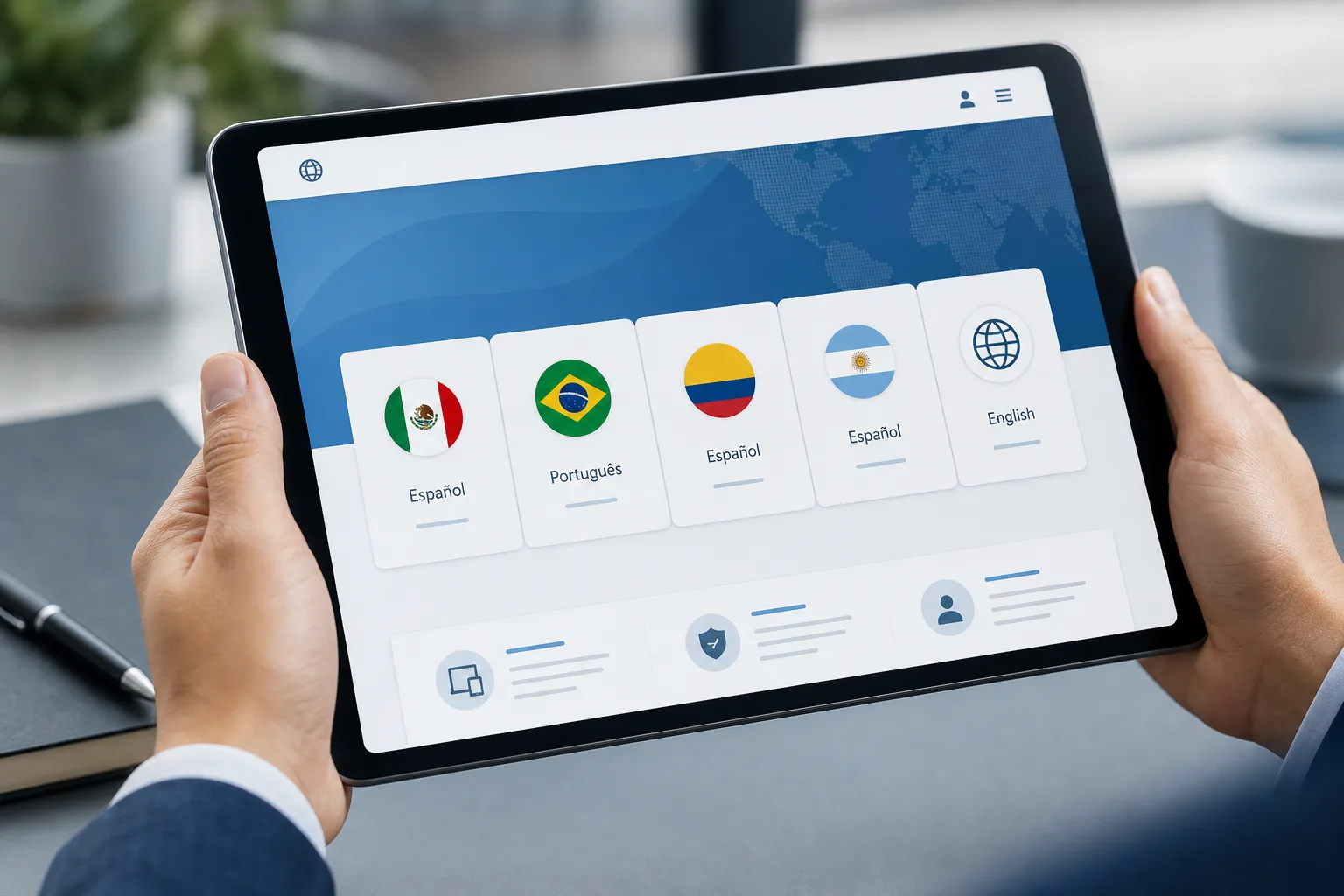
The Miami Advantage: Why Language Access Is a Business Imperative
Miami’s unique demographic makeup amplifies the translation needs of every industry listed above. According to the U.S. Census Bureau, Miami-Dade County has one of the highest rates of LEP residents of any major U.S. county — with over 53% of the population speaking Spanish at home, plus significant communities speaking Haitian Creole, Portuguese, French, and numerous other languages.
This means that for Miami businesses, translation isn’t a niche service — it’s a standard operational requirement. Consider:
- A hospital in Doral that doesn’t offer Spanish interpretation is turning away or underserving the majority of its patient community
- A law firm in Little Havana that relies on clients’ family members for court interpretation is exposing its clients to malpractice risk
- A tech startup in Wynwood that hasn’t localized its app for Spanish-speaking Latin American users has left its largest growth market untapped
- A bank on Brickell that doesn’t translate its mortgage documents is potentially violating fair lending requirements
The cost of inadequate translation — in legal liability, regulatory fines, lost revenue, and reputational damage — far exceeds the cost of doing it right. Professional translation services aren’t an overhead expense; they’re a business investment with measurable returns.

Frequently Asked Questions
Which industry uses translation services the most?
Healthcare and legal services typically have the highest volume of translation and interpretation needs, driven by regulatory mandates and the serious consequences of language errors in clinical and legal settings. In Miami specifically, immigration services also rank extremely high due to the city’s role as a major entry point for immigrants and asylum seekers.
Do I need a certified translator or is a professional translator enough?
It depends on the context. Certified translation — where the translator provides a signed declaration of accuracy and competency — is required for USCIS submissions, court documents, and many government filings. Professional translation without certification is appropriate for business materials, marketing content, websites, and internal documents. At ITU, we provide both types; contact us to discuss which is right for your situation.
What happens if I use AI translation for official documents?
AI translation tools like Google Translate or DeepL are not accepted for any official government or legal purpose. USCIS explicitly requires that translations be done by a competent human translator who certifies their accuracy. Using AI-generated translations for official submissions will result in rejection and can cause serious delays in immigration proceedings, court cases, or licensing applications.
How quickly can ITU provide translation services in Miami?
For standard documents, turnaround is typically 24–48 hours. For urgent needs — such as emergency court filings or same-day medical interpretation — we offer rush services. Call (305) 747-5996 to discuss timing for your specific project.
Does ITU Translation Services work with businesses outside Miami?
Yes. While we are headquartered in Miami and serve clients throughout Miami-Dade, Broward, and Palm Beach counties, we work with clients across all 50 states. Our remote interpretation and online translation delivery capabilities mean geography is never a barrier. Visit our Why Us page to learn more about our national reach.
Partner With Miami’s Full-Service Translation Experts
Whether you’re a healthcare provider navigating language access compliance, a law firm handling immigration petitions, a bank serving Latin American clients, or a tech company ready to expand into new markets — professional translation is a business-critical function, not an afterthought.
At International Translations USA (ITU), we’ve spent years helping Miami’s most demanding industries communicate clearly, accurately, and compliantly across 120+ languages. From certified document translation to on-site interpretation, medical and legal specialization, and full website localization, our team is ready to support your language access needs.
📞 Call (305) 747-5996 or request a free quote online. Let’s make language a competitive advantage for your organization.
Related Articles
ITU Translation Services
ATA corporate member and BBB A+ rated translation agency in Miami, FL. Certified translations in 120+ languages, accepted by USCIS, courts and institutions nationwide since 2017.



Need a certified translation?
Free quote in minutes — USCIS acceptance guaranteed.